Mtskheta, Georgia: Complete Travel Guide (Day Trip)
Mtskheta is Georgia's ancient capital, just 25km from Tbilisi. Visit Svetitskhoveli Cathedral, Jvari Monastery & Samtavro. Tips on getting there by rental car.
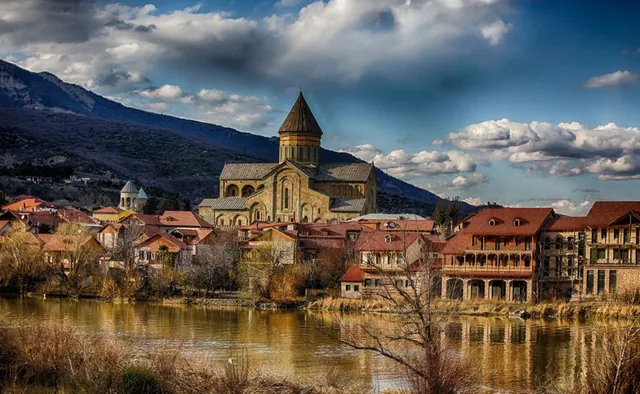
If you're planning a trip to Georgia — the country in the South Caucasus, not the US state — Mtskheta is almost certainly already on your radar. And it should be. Just 25 kilometres (about 15 miles) north of Tbilisi, this small town packs more history, spiritual weight, and raw atmosphere into a few square kilometres than most cities manage in a lifetime. It's one of the oldest continuously inhabited places in the region, a UNESCO World Heritage Site, and the spiritual heart of the entire country. The best part? You can be there in under 30 minutes.
Why Mtskheta Matters: A Very Quick History
Mtskheta isn't just old — it's ancient in the way that makes you stop and recalibrate. Archaeological evidence suggests people have lived here since at least the second millennium BC, and the city itself took shape around the 5th–6th centuries BC. For several centuries it served as the capital of the Kingdom of Iberia, the early Georgian state that eventually grew into modern Georgia.
The defining moment came in 337 AD, when King Mirian III converted to Christianity — largely through the influence of St. Nino of Cappadocia, a missionary who had made her way here from the Roman world. That moment turned Mtskheta into the cradle of Georgian Christianity and earned it the unofficial title of the "Second Jerusalem." Even after the capital moved to Tbilisi in the 5th century, Mtskheta never lost its religious significance. Georgian kings continued to be crowned and buried here for centuries.
In 1994, the historic monuments of Mtskheta were inscribed on the UNESCO World Heritage List. Today the town has a population of around 8,000 people — though on a busy tourist day, it might not feel like it.
What to See in Mtskheta
Svetitskhoveli Cathedral
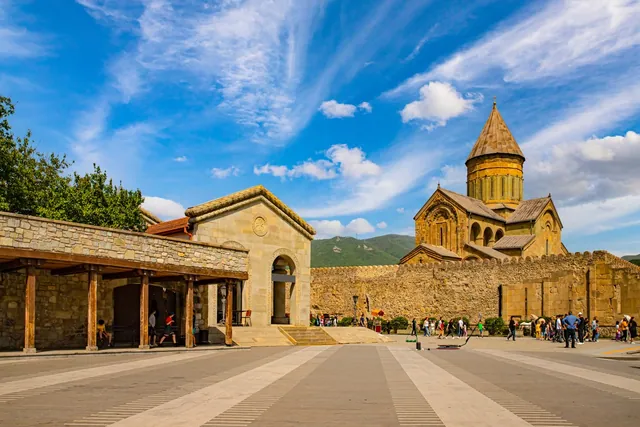
This is the centrepiece of Mtskheta — and arguably one of the most important Christian sites in the entire Caucasus. The name translates from Georgian as "Life-Giving Pillar," a reference to one of the most enduring legends in the country: that the robe of Jesus Christ was brought here from Jerusalem and buried in the very ground where the cathedral now stands.
The building you see today dates from the 11th century, constructed between 1010 and 1029. For over a thousand years, it served as the main cathedral of the country, hosting royal coronations and burials. It remains the largest surviving historic structure in Georgia.
Practical info: Open daily 8:00 AM – 7:00 PM. Free entry. Women are required to cover their heads and wear a skirt — scarves and wraps are available to borrow at the entrance.
Jvari Monastery
Perched on a rocky hilltop above the town, Jvari Monastery overlooks the confluence of the Mtkvari (Kura) and Aragvi rivers — two currents of visibly different colours merging into one. The view is genuinely breathtaking.
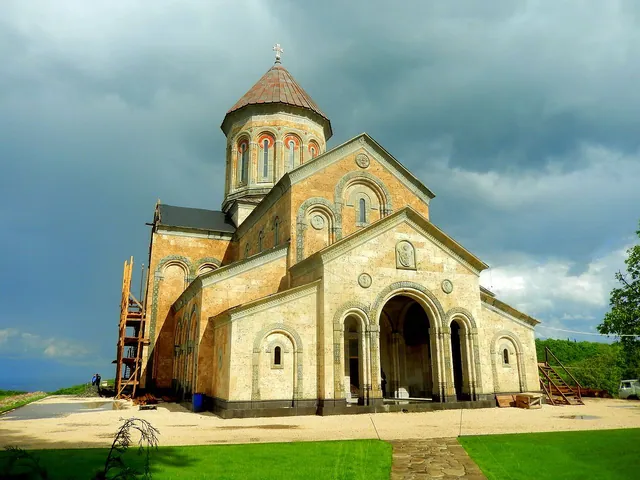
Jvari was built in the late 6th and early 7th centuries (approximately 585–604 AD) on the site where, according to tradition, St. Nino erected the first wooden cross in Georgia. "Jvari" means "cross" in Georgian. The monastery is considered a masterpiece of early medieval Christian architecture and is also a UNESCO World Heritage Site.
For literary travellers: the Russian Romantic poet Mikhail Lermontov visited Mtskheta and Jvari during his posting in the Caucasus in the 1830s, and scholars believe this landscape directly inspired his narrative poem Mtsyri.
One important note: Jvari is located across the river from central Mtskheta, on a hilltop about 10 km from the train station. You cannot walk there from town. The realistic options are taxi or your own car — which is the main reason a rental vehicle transforms this trip from a simple sightseeing run into a complete experience.
Samtavro Monastery
A five-minute walk from Svetitskhoveli, Samtavro Convent is quieter, smaller, and often more affecting. It's a working nunnery — the tombs of King Mirian III and Queen Nana are here. Set aside 20–30 minutes.
The Old Town and the Riverside
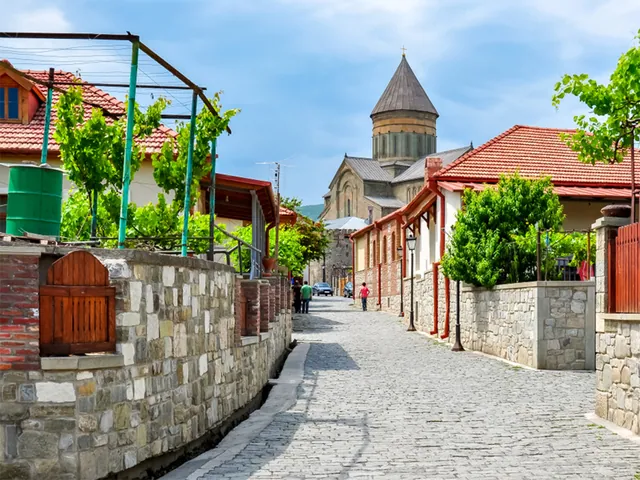
After the big churches, take time to simply walk. Mtskheta's tourist street runs from the main car park toward Svetitskhoveli and down to the river. Along the way you'll find churchkhela (a traditional Georgian candy — nuts threaded on a string and dipped in grape juice), local wine, handicrafts, and spices. Prices are a little higher than in Tbilisi, but nothing outrageous.
Getting to Mtskheta from Tbilisi
By rental car — by far the most practical option, especially if you want to visit Jvari. Take the Tbilisi–Senaki–Leselidze Highway and follow signs for Mtskheta. There's a paid car park right next to Svetitskhoveli Cathedral (2 GEL). Jvari has its own separate parking area on the hilltop. Arrive early — spaces fill up fast. Browse available cars at mydrive.club — free delivery anywhere in Tbilisi, no mileage limits.
Mtskheta also sits perfectly on the road to Kazbegi, Gori, and Uplistsikhe — all in the same general direction. A rental car lets you turn a single Mtskheta visit into a full-day multi-stop itinerary.
By minibus (marshrutka) — departs from Didube Bus Station every 15–20 minutes, 7:30 AM to 8:30 PM. Fare: 2 GEL. Stops near Svetitskhoveli. Cannot reach Jvari.
By taxi — round trip from Tbilisi with waiting time: approx. 50–60 GEL (~$18–22).
By train — runs on schedule and is cheap, but the station is 2 km from the town centre and 10 km from Jvari.
The bottom line: for a complete visit including Jvari, a rental car or taxi is essentially your only realistic option.
Practical Tips
How long do you need? 1.5–2 hours for Svetitskhoveli and Samtavro. Add Jvari and the drive, and you're looking at 3–4 hours total.
Best time to visit. Year-round destination. Spring (April–May) and autumn (September–October) are most pleasant. Summers are hot (~30°C / 86°F) and crowded. Aim for a weekday morning.
Dress code. Women must cover their heads and wear a skirt inside the churches. Scarves and wraps available to borrow at the entrance. Men should remove hats.
Language. English is not widely spoken locally. A translation app is helpful.
Where to eat. Several solid Georgian restaurants in town — khinkali, khachapuri, grilled meats. Slightly higher prices than Tbilisi.
Is It Worth the Trip?
Mtskheta isn't a box to check off. It's one of those rare places where history feels tangible — where you're standing inside a cathedral that has been the spiritual centre of a nation for 1,700 years and it doesn't feel like a museum. The view from Jvari over the meeting of two rivers is one of the most quietly extraordinary things you'll see in the whole region. And it's half an hour from your hotel.
Drive there. You won't regret it.