Nekresi Monastery in Kakheti: An Ancient Sanctuary Above the Alazani Valley
Nekresi Monastery in Kakheti, Georgia — one of the oldest in the country. How to get there by rental car, what to see, ancient frescoes, panoramic views. Complete visitor guide.
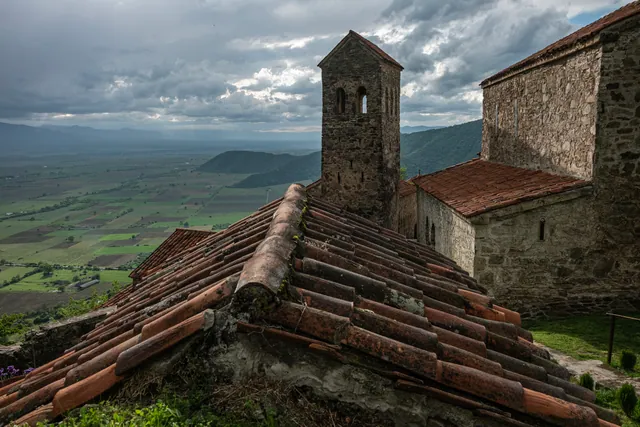
Some places hit differently than any guidebook or museum tour can prepare you for. Nekresi Monastery is one of them. It sits on a forested hilltop above the sweeping Alazani Valley, and the first thing you feel when you finally reach the top isn't the burn in your legs — it's a quiet, disorienting sense that time has stopped working. Below you, vineyards stretch to the horizon. In the distance, the ridges of the Caucasus cut across a pale sky. And right beside you: walls that have stood for fifteen hundred years.
Nekresi doesn't have the name recognition of Mtskheta or Vardzia among first-time visitors to Georgia. But ask anyone who's been, and they'll tell you it belongs on the list. This is Georgia beyond the tourist trail — ancient, unhurried, and completely genuine.
Getting to Nekresi Monastery
Nekresi is located in the Kvareli Municipality of the Kakheti region, about 11 km (7 miles) from the town of Kvareli and 35 km (22 miles) from Telavi. From Tbilisi, the drive is roughly 130 km (80 miles) — plan on about two hours.
Nearest landmark: the village of Shilda, off the Kvareli–Telavi road. GPS coordinates: 41.972322, 45.760102.
The most practical way to get here is by rental car — and that's not just about comfort. Nekresi sits well off the main tourist circuit, and public transportation is essentially nonexistent. Minibuses (marshrutkas) running between Kvareli and Telavi do pass the monastery turnoff, but you'll be dropped at the junction with still 3 km (nearly 2 miles) of uphill dirt road ahead of you — a tough ask in the Georgian summer heat. With a rental car, you drive straight to the parking area at the base of the hill, then continue on foot from there — a short, pleasant walk rather than a slog.
A taxi from Kvareli is the other realistic option and won't break the bank. But if you're planning to cover several Kakheti highlights in one day — which is absolutely worth doing — a rental gives you the flexibility to set your own pace. Nekresi sits conveniently close to the Gremi fortress (7 km), the Alaverdi Cathedral, and the wine town of Sighnaghi. Stringing them together into a single day trip is easy by car and nearly impossible otherwise.
One thing to know: during peak season, private vehicles are only allowed as far as a checkpoint at the base of the hill. From there, you either walk up (perfectly doable, 20–30 minutes) or hop on the shuttle bus that runs every 30–40 minutes — more frequently on weekends. The fare is essentially nothing.
History: Where Christianity Took Root in Kakheti
Nekresi is among the oldest monasteries in Georgia, with roots stretching back to the 6th century. It was founded by Abibos of Nekresi (also known as Avib or Abo), one of the Thirteen Syrian Fathers — a group of monks from Syria who are credited with establishing Georgian monasticism. Each of the thirteen traveled to a different part of the country, founding monasteries that became the spiritual and intellectual anchors of their regions.
Abibos chose this particular hilltop deliberately. At its foot stood the thriving city of Nekresi, one of Kakheti's most important urban centers. The monastery was meant to be its spiritual heart. When Abibos became bishop, he made Nekresi his seat. For centuries, the complex functioned as the cultural and religious core of the entire region — a place where monks studied theology, copied manuscripts, and made wine.
Abibos is remembered not only as a founder but as a martyr. According to tradition, he actively resisted the spread of Zoroastrianism that accompanied Persian expansion into the region. At one point, he extinguished a sacred Zoroastrian flame with water as a direct act of defiance. He was captured and executed for it.
The monastery survived invasions, sackings, and long stretches of abandonment over the following centuries. After nearly two decades of inactivity following the Soviet collapse, monastic life resumed here in 2000 and continues today.
The city of Nekresi itself — once a thriving settlement at the foot of the hill — is long gone. Its ruins are visible from the monastery walls above: a reminder of how much has disappeared, and how much, against the odds, has survived.
What to See: The Monastery Complex
The complex is compact, but every building on the open-access grounds tells a different chapter of the story. Visitors can explore five structures, each built in a different era.
Church of St. John the Baptist (4th century) — the oldest building in the complex and one of the oldest surviving churches in Georgia. From the outside it's almost startlingly small — a plain rectangular volume of rough-cut stone. Inside, there are no frescoes, no decoration: just bare ancient stone, a few icons hung on the walls, and a candle stand. The austerity is total. And somehow, for exactly that reason, it's one of the most affecting spaces in the complex.
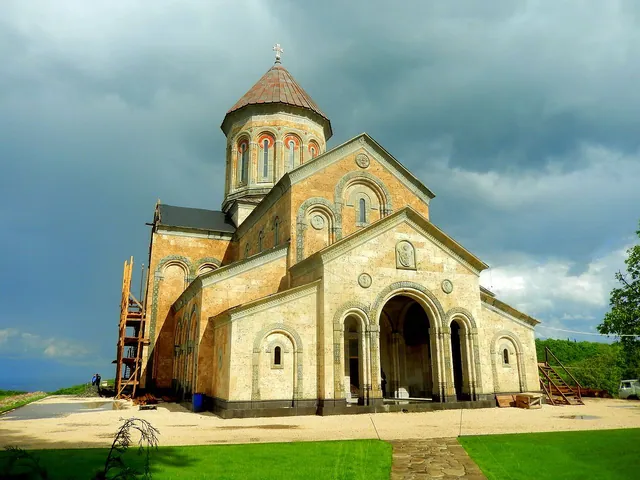
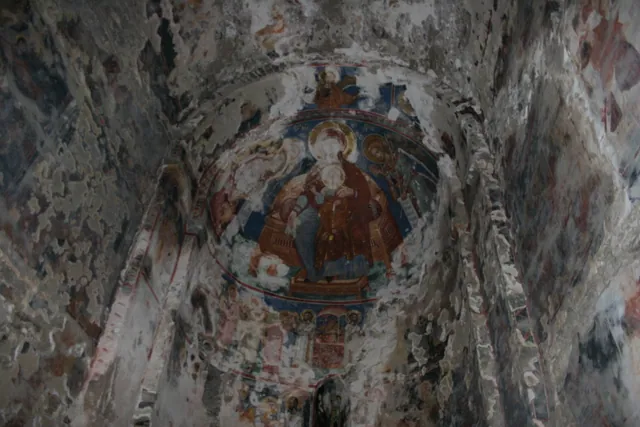
Church of the Virgin Mary (8th century) — the main church, built as a three-nave basilica. Unlike the John the Baptist church, this one has frescoes — among the earliest surviving examples of Georgian religious painting in this area. Look closely at the walls: some of the ancient images have Soviet-era inscriptions scratched over them, a strange layer of more recent history imposed on much older art. The church also contains stasidiai — tall wooden chairs used for prayer, characteristic of Orthodox churches in Greece, Cyprus, and Bulgaria, and rarely seen in Georgian churches.
The "Square Church" (9th century) — a small church with a near-square floor plan, a characteristic example of medieval Georgian ecclesiastical architecture.
The Watchtower (16th century) — a defensive structure that reflects the monastery's role as a fortified refuge during turbulent periods in Georgian history.
The Bishop's Palace — now functions as a small exhibition space, displaying icons and paintings on biblical themes.
The Marani (wine cellar) — an open gallery with floor niches designed to hold qvevri: the large clay vessels in which Georgian monks aged their wine, buried in the earth to maintain a stable temperature. It's a tangible piece of Kakheti's winemaking tradition, which predates Christianity here by thousands of years.
There's also a legend worth knowing. During one of the monastery's many sieges, monks released a herd of pigs through the gates toward the attacking forces. The sight of the animals caused the soldiers — reportedly Muslim troops — to retreat. Ever since, pigs have been considered the animals that saved Nekresi.
The View: Reason Enough to Make the Trip
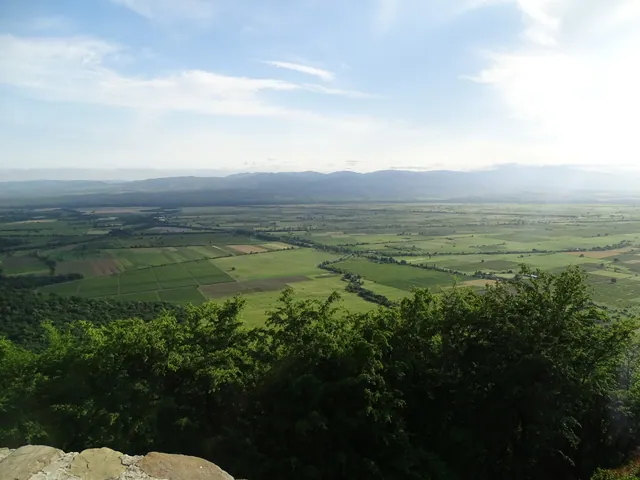
Even if ancient churches aren't your thing, the view from Nekresi's hilltop absolutely is. From up here, the Alazani Valley unfolds in every direction: endless vineyards, scattered villages, and the long ridgeline of the Caucasus on the horizon. On a clear day, the visibility is extraordinary. At dawn the valley is wrapped in mist; by midday it blazes green; at sunset the whole thing turns gold.
It's the kind of view that makes you stop talking. You just stand there and look.
Practical Information
Opening hours: 10:00 AM – 7:00 PM.
Admission: Free.
Dress code: Nekresi is an active monastery. Women should cover their heads and wear a skirt or long dress (a scarf or wrap works fine). Both men and women should have shoulders and knees covered. If you forget, a scarf is sometimes available at the entrance.
Photography: Permitted throughout the open grounds. Inside the churches, check with the monks before shooting.
Time needed: Allow 1–2 hours including the walk up and down. If you drive to the base and take the shuttle up, closer to an hour.
Best time to visit: Spring (April–May) and autumn (September–October) are ideal. Summer gets hot, and the uphill walk at midday can be punishing. In winter the road can become difficult or impassable.
What to bring: Water, comfortable walking shoes, and a sun hat in summer.
Nekresi and Nearby Sights: A Day in Kakheti
Nekresi fits naturally into a broader Kakheti day trip. A few kilometers away is the Gremi fortress complex — a 16th-century citadel with a well-preserved church tower and sweeping views of its own. Nearby Kvareli is home to the Kindzmarauli wine company and a remarkable tunnel carved into a hillside that serves as a wine cellar. Head toward Telavi and you'll reach Alaverdi Cathedral, one of the largest medieval churches in Georgia.
Covering all of this in one day is realistic with a rental car. It's the kind of itinerary that's simply not possible by public transit — the connections don't exist, and the timing doesn't work. Behind the wheel, you move on your own schedule, stop where you want, and spend as long as you like at each place. The roads in Kakheti are good, traffic outside the towns is light, and the drive itself — through one of Georgia's most beautiful wine-growing landscapes — is worth savoring.
Nekresi is one of those places that resists adequate description. The only real way to understand it is to make the drive out, walk up the hill, and stand at the edge of the terrace with the valley spread out below you. That's the moment you'll understand why people keep coming back to Georgia.