Didgori Battle Monument, Georgia: Visitor Guide, History & How to Get There
The Didgori Memorial is 57 km from Tbilisi — giant stone swords, bronze warriors, and one of Georgia's most important historical sites. Free entry. Car rental recommended.
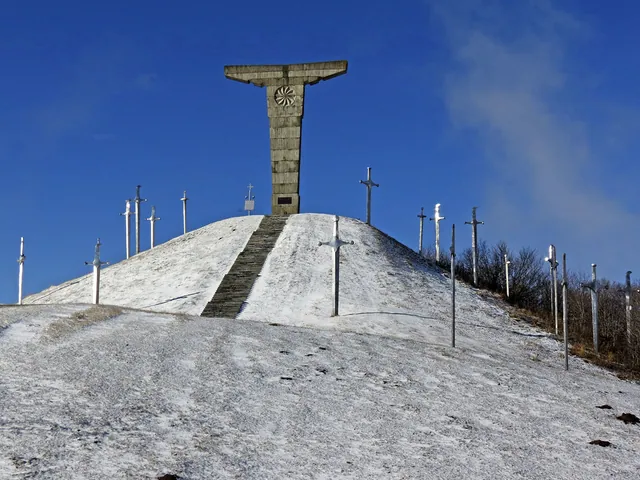
Some places aren't on the typical tourist trail — and that's exactly what makes them worth visiting. The Didgori Memorial Complex, perched on a windswept plateau 57 kilometers southwest of Tbilisi, is one of those places. Massive stone swords thrust into the ground, bronze warrior figures rising against the sky, and an open highland silence that somehow still carries the weight of a battle fought nine centuries ago.
If you're visiting Georgia and haven't made it out to Didgori yet, this is your sign to rent a car and go.
What Is the Didgori Monument?
The Didgori Memorial Complex was built in 1976, designed by prominent Georgian sculptor Merab Berdzenishvili and architect Giorgi Chakhava. It commemorates one of the most pivotal moments in Georgian history — the Battle of Didgori, fought on August 12, 1121.
The monument sits on the Didgori Plateau at the intersection of three Georgian regions — Mtskheta-Mtianeti, Shida Kartli, and Kvemo Kartli — on the edge of the Trialeti National Park. GPS coordinates: 41.7626, 44.5125.
This isn't a memorial in the conventional sense — a statue on a pedestal with a plaque. It's a symbolic battlefield: a central stele at the top of a hill, reached by wide ceremonial steps, surrounded by enormous stone swords driven into the earth like grave markers over fallen warriors. A colonnaded amphitheater sits at the base, framing sweeping views of the mountain ridges beyond. The whole complex feels immersive rather than merely decorative — more like stepping into history than observing it from behind a rope.
The Battle That Changed Georgia
To understand why this site matters so deeply to Georgians, you need a bit of context — and it's a genuinely remarkable story.
By the 11th century, most of Georgia had been overrun by the Seljuk Turks. Tbilisi — the future capital — was under their control. In 1089, David IV, known as David the Builder, was crowned king at just 16 years old. Over the following decades, he set about rebuilding his fragmented kingdom: unifying rival principalities, overhauling the military, and settling the fierce Kipchak nomads in Georgia as a fighting force.
By 1121, a coalition of Muslim rulers — Seljuk forces under emirs Il-Ghazi, Toghrul, and Dubais — invaded Georgia with the intention of crushing the resurgent kingdom once and for all. Their army numbered in the hundreds of thousands by some accounts. David met them with a force of around 56,000 to 60,000 men — Georgians, Ossetians, Kipchak cavalry, and even a detachment of Crusader knights from Western Europe.
David chose his ground deliberately. In the narrow mountain gorges near Didgori, the enemy's vast numerical advantage was useless — there simply wasn't room to deploy it. The battle lasted just three hours. Il-Ghazi's army was routed, the emir himself seriously wounded, and the remnants of the coalition force were pursued by Georgian cavalry for days afterward.
The following year, David liberated Tbilisi, which became the capital of a unified Georgian kingdom. What followed is known in Georgian history as the Golden Age.
Historian Donald Rayfield described the battle as having destroyed Muslim hegemony over Georgia and Armenia in a single afternoon. Georgian scholar S. Kakabadze called it the greatest achievement in his people's history. It's hard to argue with either assessment.
What to See at the Site
The memorial grounds are spacious, and a full walk-through takes around 30 to 40 minutes. Here's what you'll find:
The Central Stele — a tall monument at the hilltop, decorated with bas-reliefs and the Borjgali (Georgia's ancient solar symbol). The wide staircase leading up to it offers mountain views the whole way.
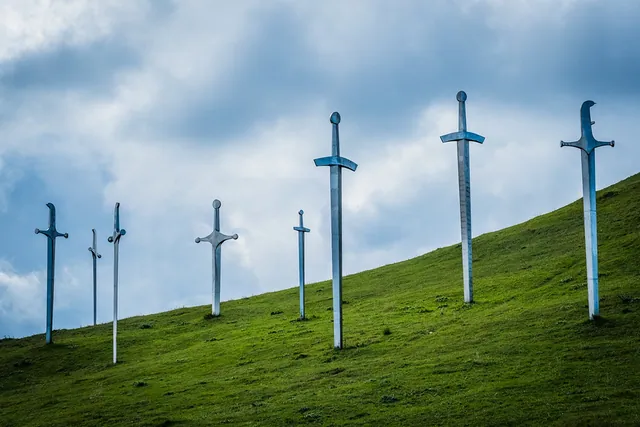
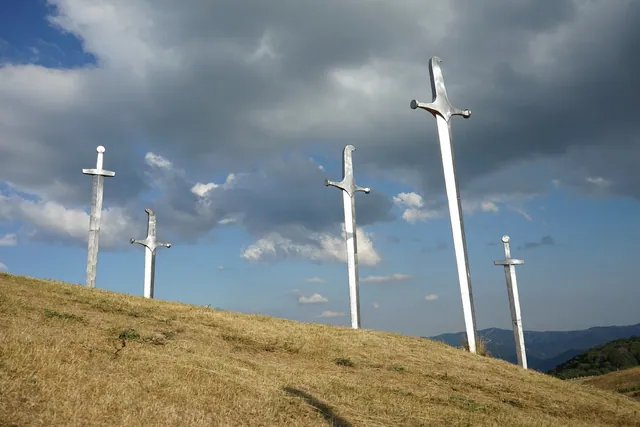
The Stone Swords — the signature image of the complex, planted along the hillside and catching the light at different angles throughout the day. These are what most visitors photograph first.
Bronze Warrior Figures — monumental sculptures placed around the complex that give the site its battlefield atmosphere.
The Colonnaded Amphitheater — at the lower end of the grounds, a good spot to sit, take in the landscape, and let the place sink in.
Bells and Ritual Objects — completing the symbolic ensemble of the complex.
One thing worth mentioning: Didgori doesn't get anywhere near the tourist traffic of Tbilisi's Old Town or Mtskheta. On a weekday, you may have the entire place to yourself — which, for a site like this, is a genuine gift.
Admission is free. Parking at the base of the monument is also free.
Didgoroba: The Best Day of the Year to Visit
If you can time your trip to August 12th, do it. That's when Georgia celebrates Didgoroba — the national holiday marking the anniversary of the battle.
The grounds around the memorial come alive with:
- military award ceremonies, including presentation of the Cross of Didgori — a state decoration for acts of courage;
- theatrical performances and historical reenactments;
- live music and folk celebrations;
- sporting competitions.
Thousands of people travel from across Georgia for the occasion. The atmosphere manages to be both festive and genuinely moving — the kind of national pride that doesn't feel performed.
How to Get to Didgori
Here's the key practical detail: Didgori has no public transportation link to Tbilisi, and getting there without a vehicle isn't really feasible.
There's no marshrutka (minibus) route to the monument. The nearest village reachable by shared transport is several kilometers away with a steep uphill road from there — and traffic on that stretch is sparse enough that hitchhiking isn't a reliable plan.
Your realistic options are three:
1. Rental car — by far the best way to do this. From Tbilisi, head southwest toward Manglisi, then follow the signs for Didgori. The drive takes about an hour. Navigation is easy — search "Didgori Monument" in Google Maps or Waze, or plug in coordinates 41.7626, 44.5125 directly. The paved road goes almost to the site itself, and there's a free parking area at the base.
The real advantage of driving yourself is flexibility: Didgori pairs naturally with a full day's loop through the southwest — Manglisi, Tsalka Canyon (Dashbashi), and the famous glass-bottomed observation bridge. Book through MY.DRIVE — free city delivery, no mileage limits, online booking in minutes.
2. Taxi — workable, but requires some planning. You'll need to arrange in advance for the driver to wait for you, since there's nothing to hail on the way back. A one-way drop-off leaves you stranded.
3. Organized tour — several Tbilisi-based operators run day trips that include Didgori alongside Tsalka Canyon and Dashbashi. A solid option if you'd rather not navigate independently.
What to See Nearby
The Didgori drive fits naturally into a broader day trip from Tbilisi. A few places worth adding to the route:
Manglisi — a small town about 20 km from the Didgori turnoff, home to the Manglisi Cathedral, one of Georgia's oldest Christian churches, dating to the 4th–5th centuries. Easy to combine with a Didgori visit.
Tsalka Canyon (Dashbashi) — a dramatic gorge with a waterfall and Georgia's well-known glass-floored observation bridge suspended above the canyon. One of the most photogenic spots in the country.
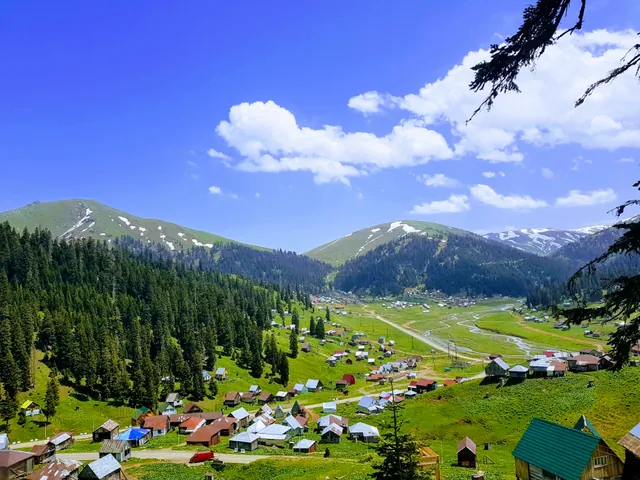
Trialeti National Park — the natural backdrop to the whole area. Rolling highland meadows, forested slopes, and very few other people.
Best Time to Visit
Late spring and summer (May–August) is peak season for good reason. The hillsides around the monument are covered in wildflowers, the green slopes contrast beautifully with the grey stone, and the light in the mountains is excellent for photography. August also brings Didgoroba on the 12th.
Autumn is quieter and equally atmospheric — muted colors, golden foliage, and noticeably fewer visitors than summer.
Winter — the plateau is striking under snow, with a stark, almost otherworldly quality to it. However, the road to the monument is frequently closed due to snowfall in winter and may simply be inaccessible. If you're planning a winter visit, check conditions before heading out. Bear in mind that even in good weather, Didgori sits considerably higher than Tbilisi — temperatures can be well below freezing on the plateau while it's mild in the city.
Practical Tips
- Dress warmer than Tbilisi's weather suggests: the plateau sits significantly higher than the city, and the temperature difference can be 5–10°C (9–18°F). It's always windy at Didgori — a jacket or at least a warm layer is a good idea even in midsummer.
- Bring water and snacks: there are no cafes or shops near the monument.
- Download your maps offline before leaving Tbilisi — cell signal can be patchy on parts of the route.
- Morning or late afternoon tends to give the best light on the swords and sculptures.
- Free entry — no tickets, no queues, no booking required.
The Bottom Line
The Didgori Memorial isn't a box-ticking stop. It's a place where the history of Georgia becomes something you can feel rather than just read about — in the scale of the monument, in the wind across the open plateau, in the quiet that settles between the stone swords.
For visitors to Georgia, it's a rare chance to step outside Tbilisi's Old Town and encounter a very different side of the country — one that's highland, historical, and far less crowded. A rental car, a free day, and an hour's drive is all it takes.
Distance from Tbilisi: ~57 km (35 miles) Drive time: ~1 hour Admission: Free Coordinates: 41.7626, 44.5125 Best season: May – August