Bodbe Monastery Georgia: Complete Visitor's Guide
Everything you need to visit Bodbe Monastery in Georgia — history, what to see, Saint Nino's spring, opening hours and how to get there by rental car from Tbilisi.
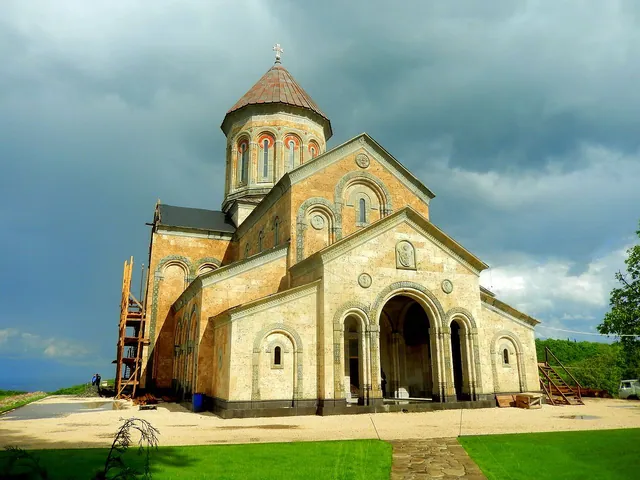
Some places are worth visiting not for the photos, but for something harder to put into words. Bodbe Monastery is one of them. Tucked into the Gombori hills above the Alazani Valley in eastern Georgia, it has stood here for over a thousand years — and every day, pilgrims and travellers from dozens of countries make the journey to this hillside nunnery. Some come to pray at the tomb of the saint who brought Christianity to Georgia. Others simply come to stand quietly among the cypress trees and look out across the Greater Caucasus. Whatever brings you here, Bodbe is one of those places that tends to stay with you. This guide covers everything you need to know before you visit.
Who Was Saint Nino — and Why Does Bodbe Matter?
To understand why Bodbe is so significant, you need to know the story of the woman buried here. Saint Nino was born in the late 3rd century in Cappadocia, in what is now central Turkey. According to tradition, she was a relative of the Patriarch of Jerusalem and a cousin of Saint George the Victorious — the patron saint of Georgia.
In the early 4th century, Nino travelled to Iberia, as eastern Georgia was then known — a pagan kingdom with no knowledge of Christianity. She settled in the royal gardener's garden in Mtskheta, the ancient capital, and began to preach. She is said to have miraculously healed Queen Nana, the wife of King Mirian III, who then converted to Christianity. The king was initially hostile — according to legend, he was struck blind at the very moment he plotted against Nino, and his sight returned only through her prayers. Around 326 AD, King Mirian converted along with his entire court, making Georgia one of the earliest Christian nations in the world.
After the conversion of Georgia, Nino withdrew to Bodbe, a remote corner of Kakheti. She spent her final years here in prayer and fasting, living in a simple tent on the hillside. She died in Bodbe — sources give the year as either 335 or 347 AD. Legend has it that when King Mirian tried to transport her body to Mtskheta, neither a hundred men nor a team of oxen could move the coffin. She was buried on the very spot where her tent had stood. A monastery grew up around that grave.
A History of Coronations, Conquest and Soviet Repurposing
The first small church on Saint Nino's grave was built on the orders of King Mirian in the early 4th century. The existing monastery buildings date largely to the 9th–11th centuries, though the complex was rebuilt several times — most significantly in the 17th and 19th centuries.
Through the Middle Ages, Bodbe became one of the most important spiritual and cultural centres in Kakheti. The kings of Kakheti were crowned here. The Diocese of Bodbe was, for a long time, the wealthiest in Georgia.
In 1605, the monastery was sacked by Persian Shah Abbas I. In 1837, following the Russian Empire's abolition of the Georgian Church's autocephaly, the Diocese was dissolved and the monastery fell into decline.
The turning point came in 1888–1889, when Tsar Alexander III visited. At his instruction the monastery was restored, and in 1889 a convent was formally established — it remains active today. The Soviet era brought darker times: the monastery was closed and converted into a hospital. The revered icon of the Iveron Mother of God was used as an operating table, and the scalpel marks are still visible today. Monastic life was restored in 1991, and in 2006 Bodbe was listed as an immovable cultural monument of national importance.
What to See at the Monastery
St George's Cathedral is the main church — a three-nave basilica originally built in the 9th century. Saint Nino's relics rest beneath the altar. Photography near the altar is not permitted.
The Bell Tower is a three-storey 19th-century structure in a Russian-European style, standing beside the cathedral.
The Church of Saints Zabulon and Susanna is a small chapel dedicated to Saint Nino's parents, canonised in 1996. It's in the lower part of the gorge, near the sacred spring.
The Cathedral of Saint Nino was built between 2011 and 2019. Its triconch layout echoes the design of the medieval Bagrati Cathedral in Kutaisi. Despite being contemporary, it's already a significant example of modern Georgian religious architecture.
The Viewing Terrace offers sweeping panoramic views over the Alazani Valley and the snow-capped peaks of the Greater Caucasus — one of the best vantage points in all of Kakheti.
The Gardens and Vineyards — the monastery grounds are well maintained, with flower beds, manicured hedges and cypress avenues.
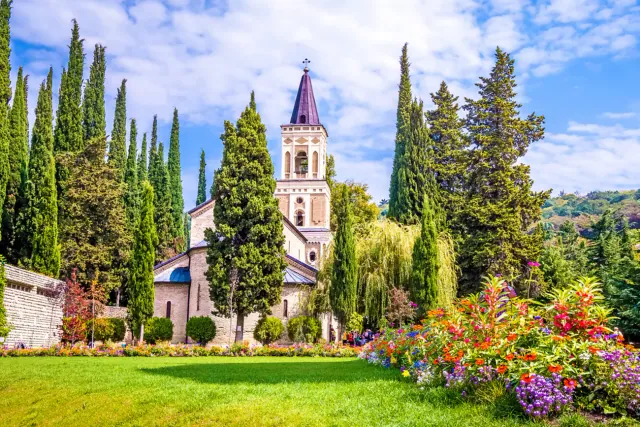
Saint Nino's Spring: Healing Waters in the Gorge
One of the main draws for pilgrims is the sacred spring, located to the northeast of the monastery in a small gorge. According to tradition, the spring emerged through Saint Nino's prayers and is believed to have healing properties. Many visitors fill bottles to take home; those who wish can also immerse themselves in the bathing pool.
Two routes lead to the spring: a footpath of around 600 metres (a pleasant downhill walk) or a longer road of about 3 kilometres by car. At the spring you'll find a small church and a bathhouse.
Practical Information: Everything You Need to Know Before You Go
Opening hours: daily, approximately 9:00 AM to 6:00 PM. Access may be restricted during liturgy.
Admission: free.
Dress code: required. Women must cover their heads and shoulders and wear a skirt — wraps are usually available at the entrance. Men should not wear shorts.
Photography: generally permitted throughout the grounds, but not near the altar.
Time needed: plan for around 1.5 to 2 hours to explore the complex and walk to the spring.
There is a small dining hall and a souvenir shop on site. Bring some cash — card payments may not be accepted everywhere.
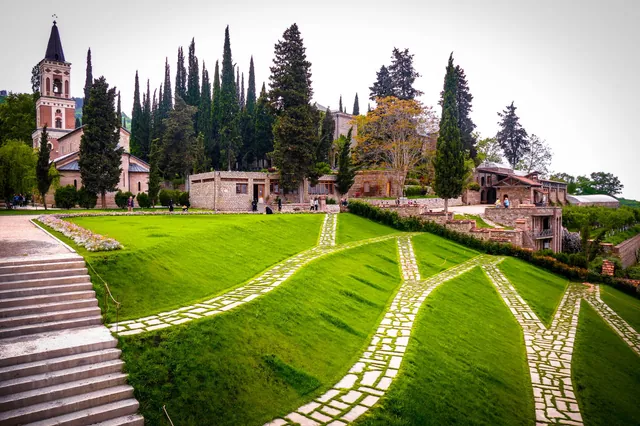
Getting to Bodbe Monastery by Rental Car
The monastery is located 2 kilometres from the town of Sighnaghi in Kakheti, around 110–115 km east of Tbilisi. The drive takes approximately 1.5 to 2 hours.
Renting a car is by far the most convenient way to reach Bodbe — and for most visitors, it's essentially the only practical option short of a taxi. There's no direct public transport to the monastery. Minibuses run from Tbilisi to Sighnaghi (from Samgori bus station, roughly 2.5 hours, around 10 GEL), but from Sighnaghi you still need to cover the last 2 kilometres to the monastery.
More importantly, Bodbe is almost always part of a broader Kakheti itinerary — Sighnaghi, Alazani Valley wineries, Alaverdi Cathedral, Tsinandali. With your own car, you set the pace, stop wherever you like and aren't tied to anyone else's schedule.
The road from Tbilisi is straightforward: head east along the main highway, then wind up to Sighnaghi. Google Maps takes you directly to the monastery gate.
You can book a rental car online in minutes — no queues, no office visits. Browse available cars at MY.DRIVE.
The main alternative is a taxi from Tbilisi, around 80–120 GEL each way, or a guided group tour. Both work, but neither gives you the flexibility of your own wheels.
Bodbe and Sighnaghi: Two Places, One Trip
Bodbe and Sighnaghi make a natural pairing. Sighnaghi is a small hilltop town with a well-preserved 18th-century city wall, terracotta rooftops and views across the same valley. Known as the "City of Love," its registry office operates around the clock. It's a good place for lunch, wine, or a browse through local galleries. The distance between the two is just 2 kilometres — less than five minutes by car. Read our full Sighnaghi guide for more on the town.
Tips for Your Visit
Go on a weekday, or early on weekend mornings. Saturdays and Sundays in summer can get busy with wedding parties and pilgrim groups.
Wear comfortable shoes. The monastery grounds are on a slope, and the path to the spring is fairly steep.
Don't rush. The atmosphere has a way of slowing people down. Many visitors who planned a quick half-hour stop end up staying far longer.
Bring some cash. The souvenir shop may not take cards.
Bodbe: Where Georgian History Becomes Tangible
Bodbe Monastery is not just another sightseeing stop. It's a place where the full sweep of Georgian history comes into focus — the arrival of Christianity in the 4th century, the coronations of medieval kings, the indignities of the Soviet period, and the revival that followed. Rent a car, drive east from Tbilisi, and within two hours you're standing at the gate of one of the most significant sacred sites in the Caucasus.