Jvari Monastery, Georgia: History, How to Get There & Visitor Guide
Jvari Monastery near Mtskheta is a UNESCO World Heritage Site built in the 7th century. Complete guide: history, architecture, how to get there by rental car or taxi from Tbilisi, opening hours and tips.
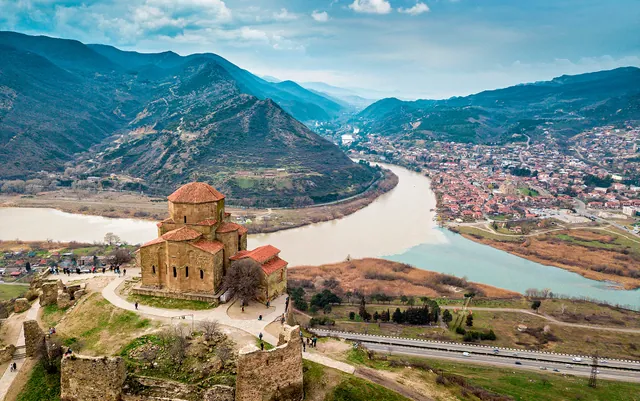
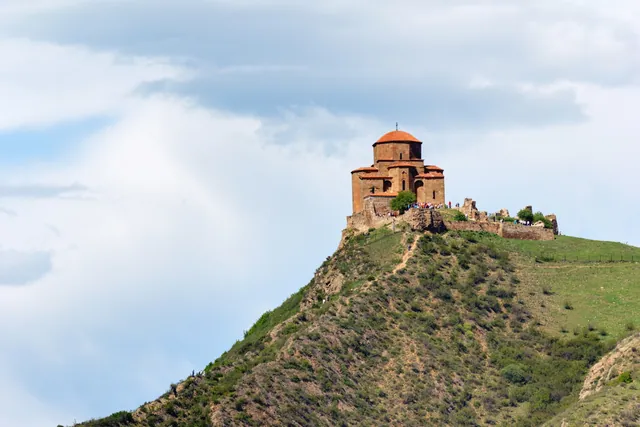
For nearly 1,400 years, a stone church has stood on a hilltop where two rivers meet — watching over the valley below and the ancient city of Mtskheta. Jvari Monastery is one of those places that makes you understand why people travel.
What Is Jvari and Why Does It Matter
"Jvari" means "Cross" in Georgian — and that single word captures the soul of this place better than any description. The monastery sits on the summit of Mount Armazi, just outside Mtskheta, about 12 miles (20 km) north of Tbilisi. From up here, you get one of the most iconic views in the entire country: directly below, the Mtkvari (Kura) and Aragvi rivers converge. What makes it visually striking is that the two rivers don't immediately blend — their waters run side by side for a stretch, different shades forming a sharp, visible line.
This exact landscape is at the heart of one of Georgia's most famous cultural connections for Russian-speaking visitors — the Romantic poet Mikhail Lermontov set his narrative poem Mtsyri here in the 1830s. For visitors from English-speaking countries, the name may not ring a bell, but the view absolutely will. This is the kind of panorama that appears on postcards, travel magazines, and desktop wallpapers — and it looks even better in person.
History: From a Wooden Cross to a UNESCO World Heritage Site
The story of Jvari starts in the 4th century AD, when Saint Nino — the woman credited with bringing Christianity to Georgia — planted a wooden cross on this hilltop. According to tradition, it was this act that prompted King Mirian III and Queen Nana of Iberia (eastern Georgia) to convert to Christianity. Georgia officially became a Christian kingdom in 327 AD, making it one of the earliest Christian nations in the world.
The spot where the cross stood became sacred. By 545 AD, a small chapel had already been built here. Then, sometime between 604 and 642 AD, a larger church was constructed on the same site — the one you see today. The architect's name has been lost to history, but the design proved so elegant and well-proportioned that Jvari became the template for Georgian ecclesiastical architecture for centuries to come.
In 1994, Jvari became the first Georgian site to be inscribed on the UNESCO World Heritage List. Between 2004 and 2007, the monastery appeared on the World Monuments Fund's list of 100 Most Endangered Sites. Serious restoration work followed, and Jvari was removed from that list by 2007.
Today it's a functioning Orthodox monastery. Services are held regularly, and the place feels nothing like a museum — which is part of what makes it special.
Architecture: Beauty Through Restraint
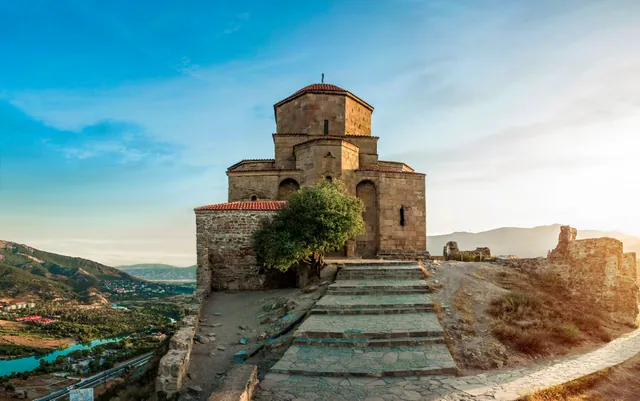
The church is built in the tetraconch plan — a cross shape inscribed within a rectangle, with four apses. It measures about 72 by 60 feet (22 by 18.4 meters). The exterior walls are decorated with carved reliefs and ornamental stonework typical of early Georgian Christian architecture: intricate but never excessive.
Step inside and the contrast is striking. There are no frescoes — they simply didn't exist in Georgia yet when Jvari was built. The interior is spare and deliberate: a large wooden cross on a stone pedestal at the center, a memorial corner for the deceased on the left, a baptismal font near the entrance, and a miraculous icon of the Iverian Mother of God on the right.
The space is small. On busy days, there may be a queue to get inside. But once you're in, something about the proportions and the light makes the noise of tourism fall away.
What Else to See: Mtskheta in a Day
Jvari is reason enough to make the trip, but the town directly below is equally worth your time. Mtskheta was the capital of the ancient Kingdom of Iberia and is one of the oldest continuously inhabited cities in the world. It's compact enough to explore on foot in a couple of hours.
Svetitskhoveli Cathedral is the centerpiece — an 11th-century cathedral that serves as the spiritual heart of Georgian Orthodoxy. According to legend, Christ's robe is buried beneath its altar. It's on the UNESCO list alongside Jvari.
Samtavro Monastery is a working convent dating from the 4th to 11th centuries. It holds the tombs of King Mirian III and Queen Nana — the royals who converted to Christianity after Saint Nino's arrival.
The old town is small but atmospheric: narrow stone streets, local wine shops, churchkhela vendors (walnut-and-grape-juice sweets), and a relaxed pace.
If you have more time and a car, the cave monastery of Shiomgvime is about 6 miles (10 km) from Mtskheta — far fewer tourists and a completely different atmosphere.
Getting There: Why a Rental Car Makes All the Difference
Here's the practical challenge: Jvari sits on top of a hill, and getting up there takes more than good intentions. There's no reliable public transport to the monastery. Walking is technically possible via a steep serpentine path (about 40 minutes up), but it's a real hike and only suits travelers who are in decent shape and traveling light.
Your two realistic options:
Taxi. From Mtskheta, local drivers offer a round trip to Jvari for around 20–30 GEL. From Tbilisi, expect to pay roughly 60–80 GEL — that's typically a round trip with the driver waiting while you visit. Split between two or three people, it's perfectly reasonable.
Rental car. For anyone who wants to set their own pace, this is the better choice by far. Tbilisi to the Jvari parking lot is about 25–30 minutes on good roads. The mountain road up to the monastery is paved and manageable in a standard car. At the top, there's a large free parking area — you're literally 2–4 minutes' walk from the entrance. Browse available cars at mydrive.club — free delivery anywhere in Tbilisi, no mileage limits.
With a rental car, you can combine Jvari, Mtskheta, Svetitskhoveli, and Shiomgvime in a single relaxed day — on your own schedule. Tbilisi has plenty of international and local rental options, and the city's road network makes getting out of town straightforward.
One winter note: if you're visiting between December and February, opt for a car with winter tires or 4WD when you book — the serpentine road can get icy. Most Tbilisi rental companies offer this as a standard upgrade.
Practical Information
Location: Mount Armazi, Mtskheta, Georgia. Search "Jvari Monastery" in Google Maps — it comes up immediately.
Opening hours: Daily, roughly 8:00 AM to 8:00 PM. Aim to arrive before 6:00 PM if you want to go inside the church.
Admission: Free.
Dress code: Women need a head covering and a skirt or long trousers. Scarves and wrap skirts are usually available to borrow at the entrance.
Shopping: Souvenir stalls at the parking area sell churchkhela, local wine, icons, and magnets. Nothing to buy once you're up at the monastery.
Restrooms: A small public toilet is located near the parking lot. Not always operational, especially in winter.
Time to budget: 40 minutes to 1.5 hours for the monastery alone. Combined with Mtskheta, plan for at least half a day.
Best Time to Visit
Spring (April–May): Comfortable temperatures (60–70°F / 15–22°C), green hills, manageable crowds.
Summer: Hot (up to 95°F / 35°C). Go early morning or at sunset for better light and fewer people.
Autumn (September–October): Golden vineyards, warm evenings, perfect photography light. Arguably the best season.
Winter: Near-empty grounds, possible snow, dramatic views. Book a car with winter tires or 4WD.
A Few Last Tips
Go on a weekday if you can — weekends in summer fill the parking lot fast and make the monastery feel crowded.
Walk the full perimeter of the grounds. The views shift as you move around — the best angles aren't always the obvious ones.
If you're driving, stop in Mtskheta on the way back rather than pushing straight to Tbilisi. Park near the old town and walk — it takes about an hour on foot.
Water and snacks are available at the stalls in the parking lot below. Once you're up at the monastery, there's nothing for sale.
Jvari has been standing on this hill for nearly 1,400 years. Whatever brought you to Georgia — the food, the wine, the mountains, the history — this is one of the places that makes the whole trip make sense.