Vardzia Cave Monastery, Georgia: Complete Visitor Guide
Everything you need to know about Vardzia, Georgia's 12th-century cave city. History, what to see, how to get there from Tbilisi, and why to rent a car.
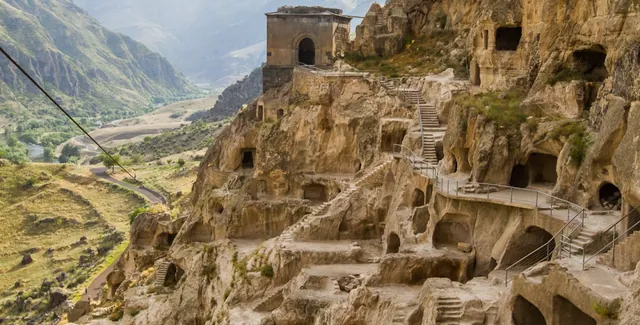
Picture a cliff rising above a river — and an entire city hidden inside it. Not ruins, not a museum reconstruction, but a living monastery with monks, 12th-century frescoes, and hundreds of caves connected by secret passageways. Vardzia is one of Georgia's most extraordinary sights and the kind of place that stays with you long after you leave. This guide covers everything you need to know before your visit: history, what to see, how to get there, and why renting a car is the only genuinely comfortable way to do it.
A City in the Rock: A History Nearly 900 Years in the Making
Construction of Vardzia began in the second half of the 12th century under Georgian King George III. The location was no accident: a sheer volcanic tuff cliff in the Mtkvari (Kura) River valley in the Samtskhe-Javakheti region was perfect for an impregnable fortress. Just three narrow passages at the base of the rock led into the interior — from the outside, the entrance was virtually undetectable.
The complex reached its peak during the reign of Queen Tamar — George III's daughter — between 1184 and 1205. It was during this golden age that Vardzia transformed from a monastery-fortress into a true cave city, complete with churches, storehouses, a treasury, refectories, bathhouses, and a library. Thousands of people lived here at its height. In 1185, the monastery was consecrated in honour of the Dormition of the Virgin Mary.
The name Vardzia, according to one popular legend, traces back to Queen Tamar's own childhood. The young princess once got lost in the caves and, frightened, called out: "I'm here, uncle!" — in Georgian, Ak var, dzia. King George III supposedly named the monastery in memory of that moment.
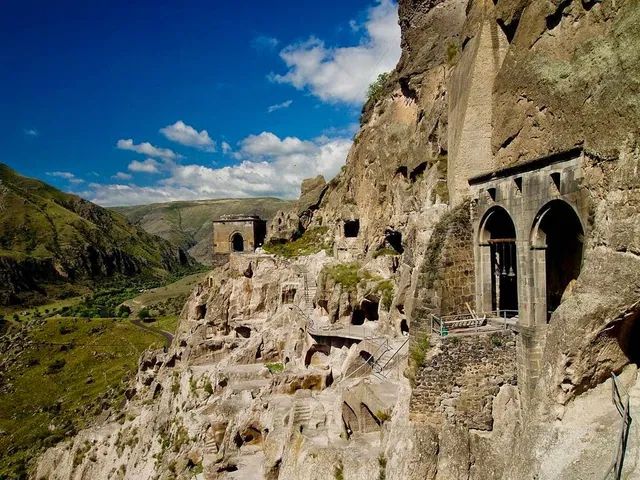
At its height, Vardzia was a true "invisible city": from the outside, the cliff appeared solid, while an entire world was concealed within. Everything changed with the earthquake of 1283, when a massive slab of rock roughly 15 metres wide broke away and fell into the river, exposing hundreds of caves to the open air. Vardzia lost its military value, but life continued. A bell tower and narthex arches were added in the late 13th and early 14th centuries.
The centuries that followed were turbulent. In the 16th century, Vardzia was seized first by Persian, then by Ottoman forces, and lay largely abandoned for two and a half centuries. After the Russian Empire took control of Samtskhe-Javakheti in 1828, monastic life was gradually revived. During the Soviet period, the monastery was closed and declared a museum-reserve. It wasn't until the late 1980s, through the efforts of Catholicos-Patriarch Ilia II of Georgia, that the liturgy was heard here again. Today Vardzia is an active monastery once more.
What to See: 600 Caves, 13 Floors, and Frescoes That Outlasted Empires
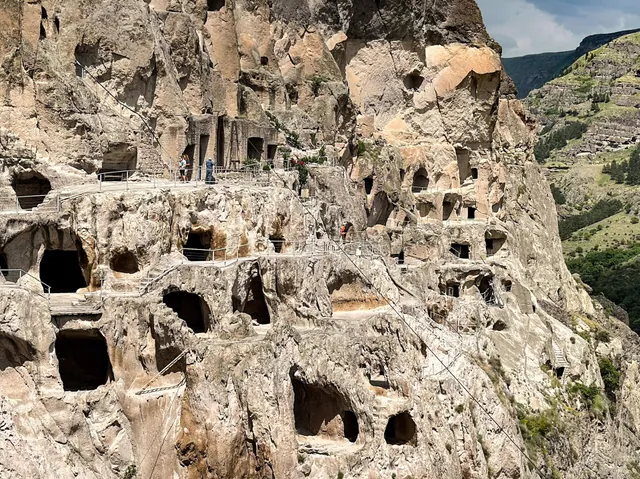
The scale of Vardzia is hard to grasp until you're standing in front of it. The complex contains over 600 rooms and chambers, and the cave city rises the equivalent of 13 storeys up the cliff face. Some corridors tunnel dozens of metres deep into the rock. Every space is connected by a labyrinth of passageways — which is what gives Vardzia the feeling of a living, breathing organism rather than a historical monument.
The Church of the Dormition of the Virgin is the heart of the complex. Its walls are covered in 12th-century frescoes depicting the Last Supper, the Washing of Feet, and the Last Judgement. Among the most historically significant are the portraits of Queen Tamar and King George — painted during their lifetimes and surviving eight centuries to the present day.
Beyond the church, it's worth exploring the monks' cells, storerooms, and the bathhouse complex — an engineering achievement that remains impressive even by modern standards. The monastery had its own sewage and water supply systems, and secret passages connected every part of the city. Today, four monks live here — all that remains of a population that once numbered in the thousands.
Visits follow a one-way marked walking route. In summer, queues can form in the narrower passages, so arriving early in the morning makes a real difference. A small shuttle runs from the car park to the entrance. Admission prices change periodically — check on arrival or on the official website before you go.
On the road to Vardzia, many visitors stop at Khertvisi Fortress — a well-preserved medieval citadel perched directly above the river gorge. It's visible from the main road, and a 20–30 minute stop is easy to fit in. Also nearby is Vanis Kvabebi, a lesser-known cave monastery that shares much of Vardzia's atmosphere but far fewer crowds.
Getting to Vardzia: Why Renting a Car Makes All the Difference
Vardzia is located in the Aspindza district of Samtskhe-Javakheti, roughly 270 km (170 miles) from Tbilisi and about 100 km (62 miles) from Borjomi. Getting here by public transport is technically possible, but genuinely awkward.
There are no direct minibuses from Tbilisi to Vardzia. You first need to reach Akhaltsikhe — about a 4-hour ride — and then transfer to a local minibus departing only at around 10:30, 12:20, 16:00, and 17:20, with another hour and a half on the road. That's over 5–6 hours each way, with a connection. Miss the last return departure and you're spending the night in Akhaltsikhe.
Renting a car is by far the most practical option — and for independent travellers, essentially the only genuinely comfortable one. The drive from Tbilisi takes around 4 hours. You choose your own departure time, stop wherever you like, and can combine Vardzia with Khertvisi Fortress, the spa town of Borjomi, or Akhaltsikhe with its Rabati Castle — all in a single day at your own pace.
The road from Tbilisi is well-paved and doesn't require a 4WD. A standard car handles the route without any issues. There's a free car park right at the entrance to the complex. Taxis are an alternative but work out significantly more expensive, especially if you want to make stops along the way.
The best place to pick up a rental is Tbilisi through MY.DRIVE, where there's a wide selection at every price point. Booking in advance is advisable, particularly during peak season from June through September.
Practical Information
| Location | Aspindza district, Samtskhe-Javakheti, southern Georgia |
| Distance from Tbilisi | ~270 km / 170 miles, ~4 hours by car |
| Distance from Borjomi | ~100 km / 62 miles |
| Opening hours | Daily (active monastery) |
| Admission | Check on arrival or on the official website |
| Minibus Akhaltsikhe → Vardzia | Approx. 10:30, 12:20, 16:00, 17:20 (verify locally) |
| Minibus Tbilisi → Akhaltsikhe | From Didube bus station, roughly hourly (departs when full) |
Best Time to Visit
Vardzia is open year-round, but the most pleasant time to visit is April–June or September–October. Midsummer (July–August) brings heat and crowds — the narrow passages can get congested. In winter the site itself remains open, though some stretches of road can be icy.
To avoid the busiest periods, aim for a weekday and get there as early as possible. Allow at least 2–3 hours to explore the complex properly.
Vardzia is more than a box to tick on a Georgia itinerary. It's a place where you can touch history with your hands: walk the same stone corridors that 12th-century monks walked, stand face to face with a portrait of Queen Tamar painted in her lifetime, and listen to a silence broken only by the wind above the Mtkvari River. Those 270 kilometres are worth every one of them.