Ushguli, Georgia — Europe's Highest Village: How to Get There & What to See
Ushguli in Svaneti is a UNESCO World Heritage site at 2,200m. Medieval Svan towers, Shkhara glacier, road from Mestia. How to get there by rental car, what to see in one day or stay overnight.
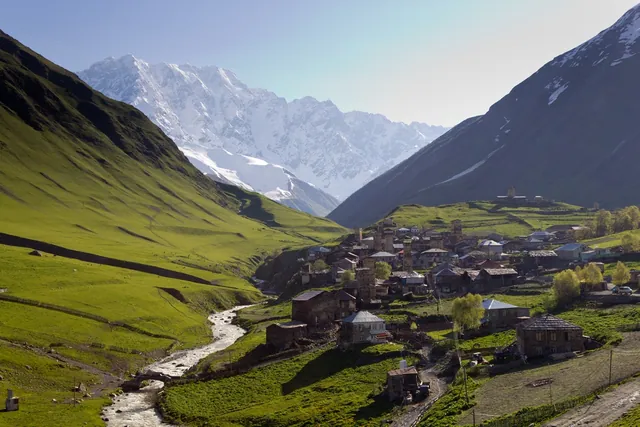
Some places you don't visit for comfort. You go for a feeling — standing before medieval towers that dissolve into the clouds, realising that some things haven't changed in centuries. Ushguli is exactly that kind of place. A high-altitude community in the heart of Svaneti, a UNESCO World Heritage Site, one of Georgia's most iconic destinations — and still a living, breathing village where horses graze in the meadows and 10th-century icons are kept behind old wooden doors.
What Is Ushguli and Where Is It?
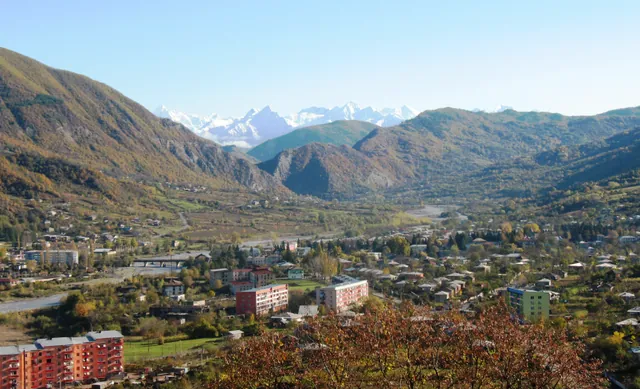
Ushguli is not a single village but a community of four settlements: Murkmeli, Chazhashi, Chvibiani, and Zhibiani. All of them sit at around 2,200 metres (7,200 ft) above sea level, in the upper reaches of the Enguri River, at the foot of Mount Shkhara (5,193 m / 17,040 ft) — the highest peak in Georgia. This is where the Svaneti and Main Caucasus ranges converge, and people have been living here since well before the 9th century, to which the oldest surviving structures are dated.
The community's total population is around 250–300 people. Ushguli is widely regarded as the highest permanently inhabited settlement in Europe — and this is not a tourist exaggeration but a documented fact. In 1996, the entire architectural landscape of the community was inscribed on the UNESCO World Heritage List as part of the Upper Svaneti site.
The name itself, according to ethnographers, derives from the Svan words ushishari guli — "fearless heart." Ushguli was never conquered.
The Svan Towers: Why They Were Built
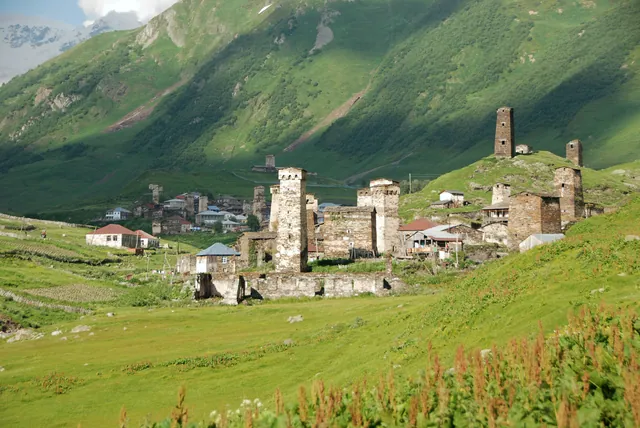
The first thing every visitor notices is the towers. Tall, square-based, built from local stone, they stand right alongside the family homes and create a skyline unlike anything else on earth.
The towers were constructed between the 9th and 13th centuries as defensive structures: when under attack, an entire family could take shelter inside and hold out for weeks. The walls are up to a metre thick or more, with almost no windows — just narrow loopholes. The Svans call their towers koshebi ("cats") — for their proud, self-sufficient character.
In Chazhashi, the towers are particularly striking, covered with traditional slate-stone slabs. On a separate hill above the settlement stands the Lower Chazhashi Castle, a cluster of several towers together. Climbing that hill is an absolute must — it offers one of the finest panoramic views across all of Ushguli. Higher up the slope sits the Upper Chazhashi Castle, traditionally said to have been Queen Tamar's summer residence. The Svans firmly believe that their legendary 12th-century queen is buried somewhere in Svaneti.
What to See in Ushguli: The Main Highlights
Lamaria Church (Church of the Dormition of the Virgin) — the oldest and most venerated church in the community, built in the 10th century at around 2,300 metres. Today it houses a small monastery. The view from the church across the valley towards Shkhara is among the most breathtaking in all of Svaneti.
Jgrag Church (St. George's Church) — a 12th-century church with unique frescoes dating from the 10th to 13th centuries. One of the most artistically significant buildings in Ushguli.
Queen Tamar's Tower — the tall black tower on a separate hillock that has become the unofficial symbol of the community. The brave can climb to its roof for a bird's-eye view over Ushguli.
Ethnographic Museum — a small private museum with a collection of Svan household objects, tools, and traditional clothing. Entry: 5 GEL (approx. $2). A good place to get a sense of how people lived here for centuries.
Icon Museum — entry 3 GEL (approx. $1). Houses authentic medieval icons painted by local craftsmen, some dating to the 10th–12th centuries.
Murkmeli, the fourth village of the community, has two churches — the Saviour and St. Barbara — and a dozen towers. The de facto centre of Ushguli is Chvibiani, where you'll find small cafés, guesthouses, and a few souvenir stalls.
The Shkhara Glacier: A Hike Worth Planning
If you've made it to Ushguli and have even half a day to spare — don't leave without walking towards the glacier. The trail to the southern slope of Shkhara and the source of the Enguri River is about 7 km (4.5 miles) one way. Much of the route can also be covered by jeep or on horseback — local families in the village are happy to arrange rides.
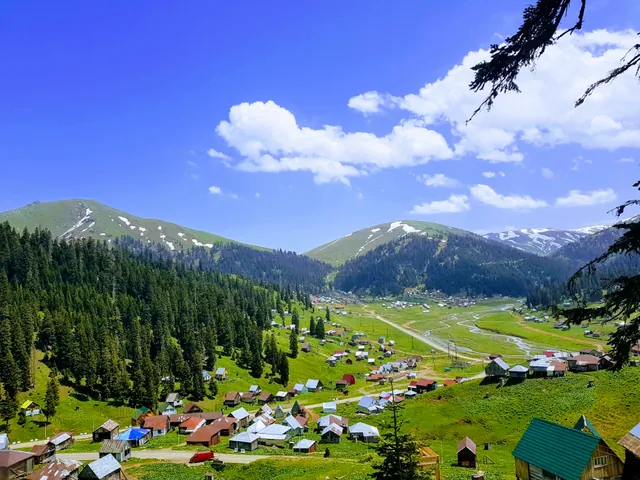
The landscape along the way is extraordinary: alpine meadows, ice-cold streams, and the peak of Shkhara ahead of you, snow-capped even at the height of summer. Even when clouds roll in and obscure the summit — which happens often — the atmosphere of this trail is worth every step.
GPS coordinates of the glacier: 42.965834, 43.096931.
The Road from Mestia to Ushguli: Getting There in 2025–2026
The distance from Mestia to Ushguli is roughly 35–40 km (22–25 miles). A few years ago, this road was a serious challenge: deep ruts, mud, and a 4WD vehicle considered essential. Things have changed significantly.
By the 2024 season, the Mestia–Ushguli road was fully resurfaced. The drive now takes about an hour in a standard car. A few short gravel sections remain, but they pose no real obstacle in dry conditions.
Important things to keep in mind:
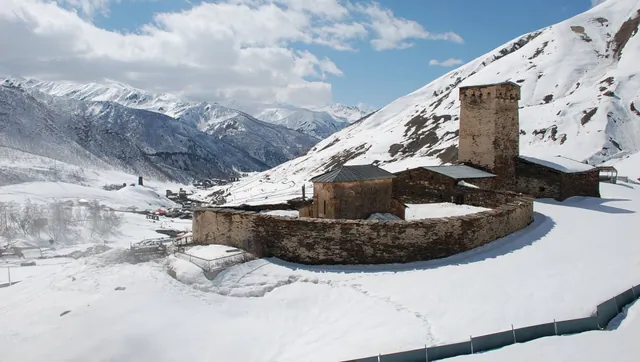
- The road is generally open from May to October. Snow makes it impassable in winter.
- Weather can affect conditions even in season — heavy rain can wash out isolated sections.
- If you're approaching Ushguli via the Zagari Pass from Kutaisi, that route is open roughly from early June to early October.
Renting a Car — The Best Way to Get There
There is no public transport to Ushguli. Your two options are a taxi or shared transfer from Mestia, or your own vehicle. A transfer from Mestia costs around €15 per person, but it locks you into a group schedule and takes away the best part — the freedom to stop whenever something catches your eye.
Renting a car in Georgia opens up a completely different kind of trip. On the road from Mestia to Ushguli, you'll pass views that make you want to pull over immediately — including the famous Love Tower near the village of Bogreshi, a solitary Svan tower above the Enguri River tied to a poignant legend about a young woman who waited a lifetime for a love that never returned. Without your own car, you'll drive straight past.
For a summer visit to Ushguli, a standard saloon or hatchback is perfectly adequate — you don't need a 4WD. That said, if you're planning to explore Svaneti more extensively — venturing into side valleys, reaching remote passes, or travelling in shoulder season — an SUV gives you noticeably more flexibility.
Book your rental car in advance through MY.DRIVE, especially for July and August: options are available in both Mestia and Tbilisi, but the better vehicles go quickly.
Stay the Night or Head Back the Same Day?
Most visitors come to Ushguli as a day trip from Mestia. That works perfectly well if you're short on time. But if the weather is clear and the mountains are visible — we'd strongly encourage you to stay overnight.
For one thing, the light here in the early morning and at sunset is something else entirely: the Chazhashi towers glowing against Shkhara at golden hour is the kind of image people travel across continents to photograph. For another, once the day-trippers have gone, Ushguli becomes itself — quiet, genuinely medieval, and surprisingly moving.
There are several guesthouses in the community. Prices are reasonable, the service is simple but warm. You can have dinner with your hosts or at one of the small cafés — including Koshki ("Cats"), right at the entrance to Chvibiani.
Practical Information
Altitude: 2,200 m (7,200 ft) above sea level. If you're not used to elevation, you may feel some mild fatigue in the first hour or two — take it easy and breathe.
Best time to visit: June to September. July and August offer the warmest temperatures and the clearest skies. May and October are beautiful but colder, and the road is less reliable.
What to bring: A warm mid-layer (even in summer it gets cold after dark), a rain jacket, and sturdy footwear for uneven stone paths.
Money: Card payments are rarely accepted. Bring Georgian lari in cash — you'll need it for museum entries, cafés, and souvenirs.
Connectivity: Mobile internet is unreliable. Download offline maps before you go — Maps.me or Google Maps with the Svaneti region saved works well.
Souvenirs: The signature Svan product is svan salt — a blend of coarse salt with local herbs, fenugreek, and garlic. You'll find it in Ushguli, but the selection is better and prices lower back in Mestia.
Museum entry: Ethnographic Museum — 5 GEL; Icon Museum — 3 GEL. Walking around the community, the towers, and the surrounding area is free.
A Final Word
Ushguli doesn't offer what's usually called tourist comfort. There are no polished restaurants, no spas, no reliable wi-fi. What it offers instead is something increasingly rare in the world: authenticity. Houses that are eight hundred years old. Horses on the meadows below the permanent snow line. People who live here not by accident, but because this is their land.
"Those who haven't seen Ushguli haven't seen Svaneti," the Svans say. And those who've been to Svaneti tend to add their own line: those who haven't seen Svaneti don't really know Georgia.
Get in the car and go. The road is good now.