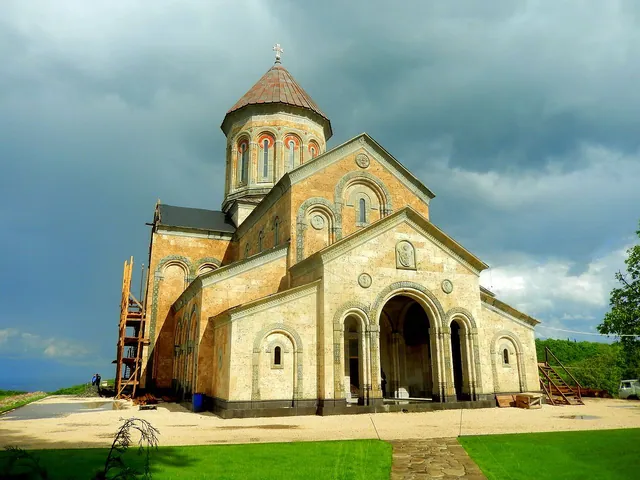
David Gareja Monastery — How to Get There by Car
David Gareja is a 6th-century cave monastery 70 km from Tbilisi. How to drive there from Tbilisi, Telavi, and Batumi — and everything you need to know before you go.
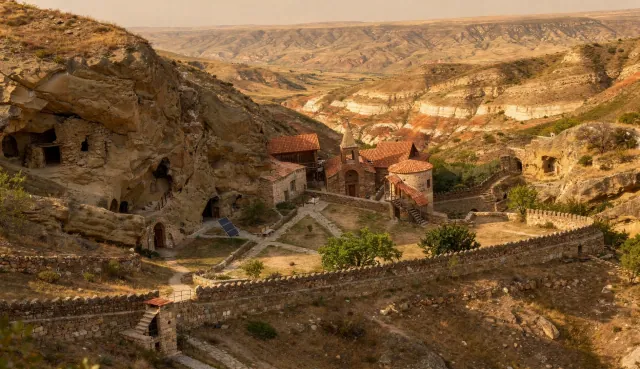
David Gareja is a 6th-century monastery complex carved into the cliffs on the Georgia–Azerbaijan border, 70 km southeast of Tbilisi. It's one of those rare places where history, landscape, and genuine remoteness all hit at once. Getting here without a car is technically possible, but awkward — the site is far from any major city, and public transport connections are essentially non-existent.
What David Gareja Actually Is
The complex was founded in the first half of the 6th century by the monk David Garejeli — one of the thirteen Assyrian Fathers who came to Georgia to spread Christianity. He settled in a natural cave in the Gareja desert with his disciple Lucian, surviving on roots and the milk of wild deer. His disciples Dodo and Lucian later founded several more monasteries nearby.
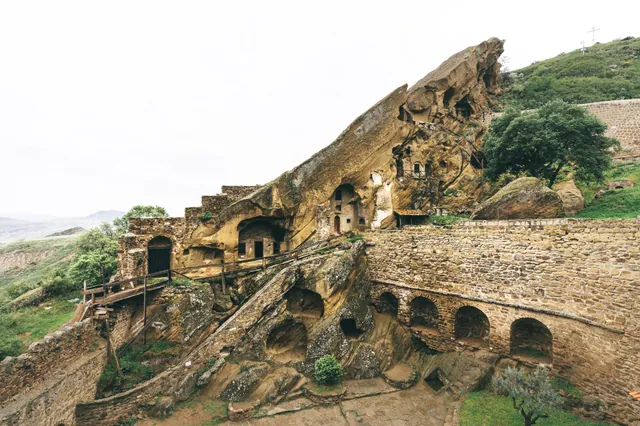
Today, David Gareja is a network of 19 cave monasteries spread across roughly 25 km along the Gareja Ridge. Churches, monks' cells, refectories, and storage rooms are all hollowed out of the rock face. The walls hold frescoes from the 12th and 13th centuries in remarkable condition — portraits of King David the Builder, Queen Tamar, and Demetrius the Self-Sacrifice. There are also inscriptions in Georgian, Armenian, Arabic, and Greek: more than forty examples within the complex alone.
The monastery's golden age was the 11th–13th centuries, during the height of unified Georgia. A private school of fresco painting operated here, and thousands of manuscripts were kept within its walls. After that came the Mongol raids of 1265, Tamerlane's campaigns, and the devastation by the Iranian Safavids in 1616–1617. The Soviets shut the monastery down in 1921. Monastic life only resumed in 1991.
What You Can Actually Visit Right Now
This part is worth reading before you get in the car.
The main section of the complex — the Lavra of David — sits on Georgian territory and is open to visitors. It's a functioning monastery: monks live and work here today. Entry is free; dress code applies.
Udabno Monastery (home to the most celebrated frescoes) sits on the ridge that forms the disputed border between Georgia and Azerbaijan. Access is periodically blocked by Azerbaijani border guards. As of 2025–2026 the situation remains unpredictable — sometimes visitors get through, sometimes they don't. It's worth checking current reports in travel communities before you go.
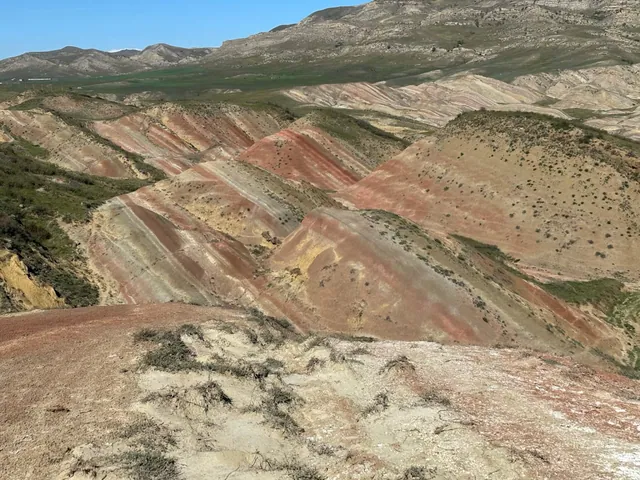
Right next to the parking area are the famous Rainbow Hills — a series of vividly striped mounds formed by Miocene and Pliocene marine sediments. Nobody is closing those, and they're a reason to come in their own right.
Getting There from Tbilisi
Tbilisi is the most common starting point. The road distance is about 70 km, and the drive takes 1 hour 15 minutes to 1 hour 30 minutes.
Route: Tbilisi → Sagarejo → Udabno → David Gareja
Take the Kakheti Highway (S5) towards Sagarejo — a new four-lane motorway section opened here in 2024, so this stretch is fast and smooth. After Sagarejo, turn south through the village of Udabno, and follow the road straight to the monastery parking area. The entire route is paved. There is no dirt road.
There is an alternative route through Rustavi and Gardabani that shows up on some maps and older guides. Skip it. The road is broken up, full of potholes, and turns into thick mud after rain — you'd need a 4WD to manage it comfortably. The Sagarejo route is faster, easier, and there's no reason to go any other way.
Leave early — ideally before 9 am. In summer the site gets hot quickly, and the morning hours are the most pleasant. Tbilisi traffic on a weekday can also add 15–20 minutes to your journey.
If you're planning a day trip from Tbilisi, renting a car there is the most flexible option. MY.DRIVE offers free delivery anywhere in Tbilisi with no mileage limit — exactly what you need for a day out. The round trip from Tbilisi to David Gareja and back is around 140 km.
Getting There from Telavi and Kakheti
From Telavi, the drive is around 100–110 km, taking roughly 1 hour 30 minutes to 2 hours. The route runs through Sagarejo on the same good asphalt.
If you're already traveling around Kakheti, folding David Gareja into the itinerary makes sense. A two-to-three day loop covering Sighnaghi, Telavi, Alaverdi, and Gareja works well. From Sighnaghi the distance is similar to that from Tbilisi — no real time saving — so the standard advice still holds: use Tbilisi as your base.
Getting There from Batumi
From Batumi, the distance to David Gareja is around 415–420 km, with a drive time of 5.5 to 6 hours. That's a serious journey, not a day trip.
The practical approach is to drive to Tbilisi first, stay the night, and head to Gareja the following morning. Alternatively, build the monastery into a Batumi–Tbilisi road trip, setting off early and stopping at Gareja on the way.
There's no good way to do Batumi and Gareja in a single day.
Before You Go: Practical Details
Best time to visit: April–June and September–October. In July and August the semi-desert hits 35–40 °C. Winter brings strong winds and cold. Spring turns the landscape surprisingly green.
How much time to budget: a minimum of 3 hours on site — the Lavra walk, the climb to the Rainbow Hills, and time to just sit on the ridge. If Udabno is open, allow 4–5 hours.
What to bring:
- Water — at least 1.5 litres per person; there is no café or shop at the site
- Sturdy footwear — the path up to the ridge is rocky
- Modest clothing to enter the monastery
- Small change for the toilet near the parking area (0.50 GEL)
Fuel: the last petrol stations are in Sagarejo or the village of Udabno. There is nothing after that.
Mobile coverage: Magti has the best signal on this route, with 4G available for most of the drive and at the monastery itself.
Opening hours: the monastery is open daily. There are no official closing times, but arriving in the morning gives you the best conditions.
Bottom Line
David Gareja is not just a monastery. It's a cave city in the desert, 12th-century frescoes, an active border dispute, and a landscape unlike anything else in Georgia. The drive from Tbilisi takes about 90 minutes on good asphalt via Sagarejo — straightforward with a car. Check the status of Udabno before you leave, bring enough water, and get there early. The rest takes care of itself.